You have probably tried the productivity apps. The timers. The accountability groups. The to do lists. The habit trackers.
And some of them probably worked for a bit. Until they did not.
Body doubling is different. Not because it is a clever hack or a new system. But because it works with how a neurodivergent brain actually functions rather than asking you to override it.
What body doubling actually is
Body doubling is simply having another person present while you do your work.
They do not need to help you with the task. They do not need to check on you or keep you accountable in any formal way. They might be sitting in the same room. On a Zoom call doing their own thing. On the phone quietly. Checking in at the start and end of a session. Working alongside you in a cafe.
It is the presence that matters, not the supervision.
Why it works for an ADHD brain
It creates activation. ADHD brains often struggle to self-start. Another person acts like an external engine. Instead of sitting there telling yourself "I need to start," something shifts and it becomes "we are starting now." That shift sounds small. It often is not.
It reduces avoidance drift. When you are alone, it is easy to wander. Snacks, scrolling, reorganising things that do not need reorganising, suddenly urgent jobs that were not urgent five minutes ago. With someone else present, your brain holds the line better. Not because you are being watched in a harsh way. More because the task feels real and anchored.
It gives gentle external accountability. If you say at the start of a session "I am going to send that invoice today," your brain now has a clearer target. ADHD brains often respond far better to external accountability than to internal promises, however sincerely meant.
It calms the overwhelm. When you are paralysed, tasks feel enormous. Having another person nearby can regulate your nervous system enough to lower the anxiety and just begin. You feel less alone with the thing, and that often makes all the difference.
Why it helps with dyslexia too
If dyslexia adds friction through reading, sequencing, or forms, body doubling helps because someone can break steps down with you, read wording aloud, sense-check an email before you send it, or just keep you on the next step when you get lost inside a task.
Sometimes the problem is not the task. It is getting lost in the middle of it and not being able to find your way back.
Why it can feel strangely powerful
You might wonder why you can work when someone else is there but not when you are alone. It can feel embarrassing to notice that about yourself.
But here is the thing. Your brain may genuinely need co-regulation, structure, and immediacy to function at its best. That is a support need, not a flaw. And once you stop fighting it and start working with it, things tend to change quite quickly.
The types of body doubling that work best
Silent co-working. Good for admin, paperwork, emails. You just need the presence.
Start-me sessions. Ten minutes together just to begin. Great if starting is consistently the hardest part.
Checkpoint doubling. Set a goal, work for twenty five minutes, report back. Good for building momentum.
Guided doubling. Someone helps you prioritise first, then you get on with it. Good for when you are overwhelmed and do not know where to start.
One thing worth knowing
Not every body doubling situation works for everyone. If the other person feels critical, too chatty, distracting, or intense, it can actually make things harder. The best body doubling partnerships tend to feel calm, warm, non-judgmental, and low pressure.
That is exactly what we try to create in NeuroThrive sessions.
The honest truth
Many people with ADHD have spent years trying to force independence. Trying to be the person who just gets on with it, alone, without needing anything from anyone.
But what actually works is often supported independence. And that is different. It is not weakness. It is knowing how your brain works and giving it what it needs.
You usually know what to do. Your brain just will not always bridge the gap between intention and action on its own.
Having someone alongside you can change that. Not every time. But often enough to be worth trying.
Come and try it
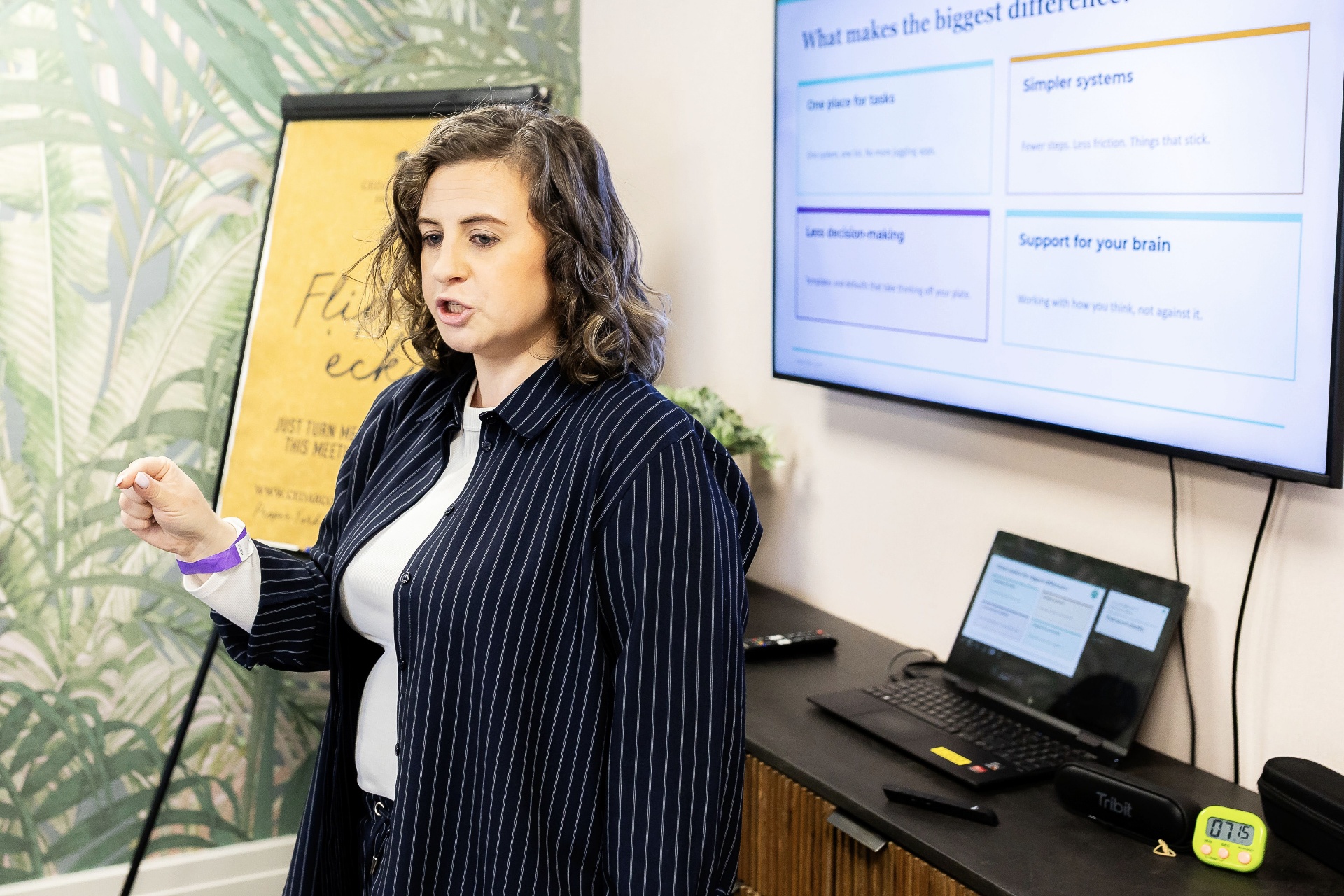
NeuroThrive runs regular body doubling sessions for neurodivergent business owners and freelancers. Bring whatever you have been putting off. Show up as you are. See what happens.
Frequently asked questions
- What is body doubling?
- Body doubling is working alongside another person while you do your task. They don't supervise or help you, they're simply present, in the same room, on a video call, or on the phone. It's the presence that matters, not the supervision.
- Why does body doubling work for ADHD?
- ADHD brains often struggle to self-start because the brain's activation system fires unreliably for low-dopamine tasks. Another person acts like an external engine, shifting "I need to start" into "we are starting now," which reduces avoidance drift and makes the task feel real and anchored.
- Do I have to talk during a body doubling session?
- No. Most sessions only need a quick check-in at the start and end. You can keep your camera off, stim, mute yourself, and just work. There's no performance and no small talk required.
- How long should a body doubling session be?
- Most people find 45 to 90 minutes works well. Long enough to settle in and get real momentum, short enough that your brain doesn't drift or burn out. If you're using it just to start something, even 10 to 15 minutes can be enough to break the freeze.
- Is body doubling the same as co-working?
- There's overlap, but they're not identical. Co-working tends to be longer, more social, and not specifically designed for neurodivergent brains. Body doubling is usually quieter, more focused, and built around starting and finishing a specific task with another person's calm presence.
- Does body doubling work online or only in person?
- Both work. A lot of neurodivergent business owners actually prefer video calls because there's no commute, less sensory load, and you can pick a partner anywhere in the world. Cameras can stay on or off, it's the shared focus time that matters, not the format.
- What if I feel self-conscious being watched while I work?
- That's normal at first. A good body doubling space isn't about being watched, it's about being witnessed. No one is judging your output, your pace, or your screen. After one or two sessions most people stop noticing the other person and just settle into the work.
Keep going, you don't have to do it alone
If this resonated, two next steps that ND brains tend to love:
- → Grab the free body doubling starter guide , a gentle on-ramp, no pressure.
- → Join NeuroThrive , weekly body doubling and a community that just gets it.